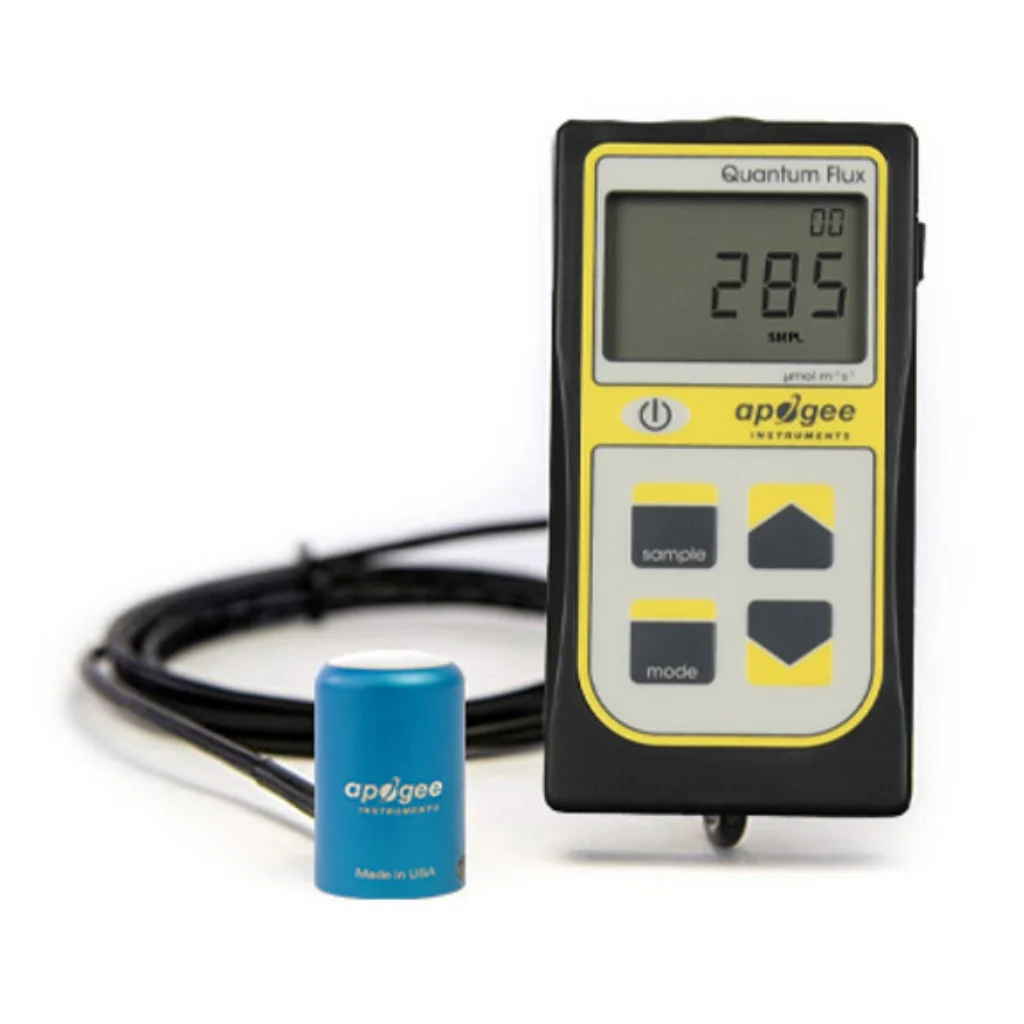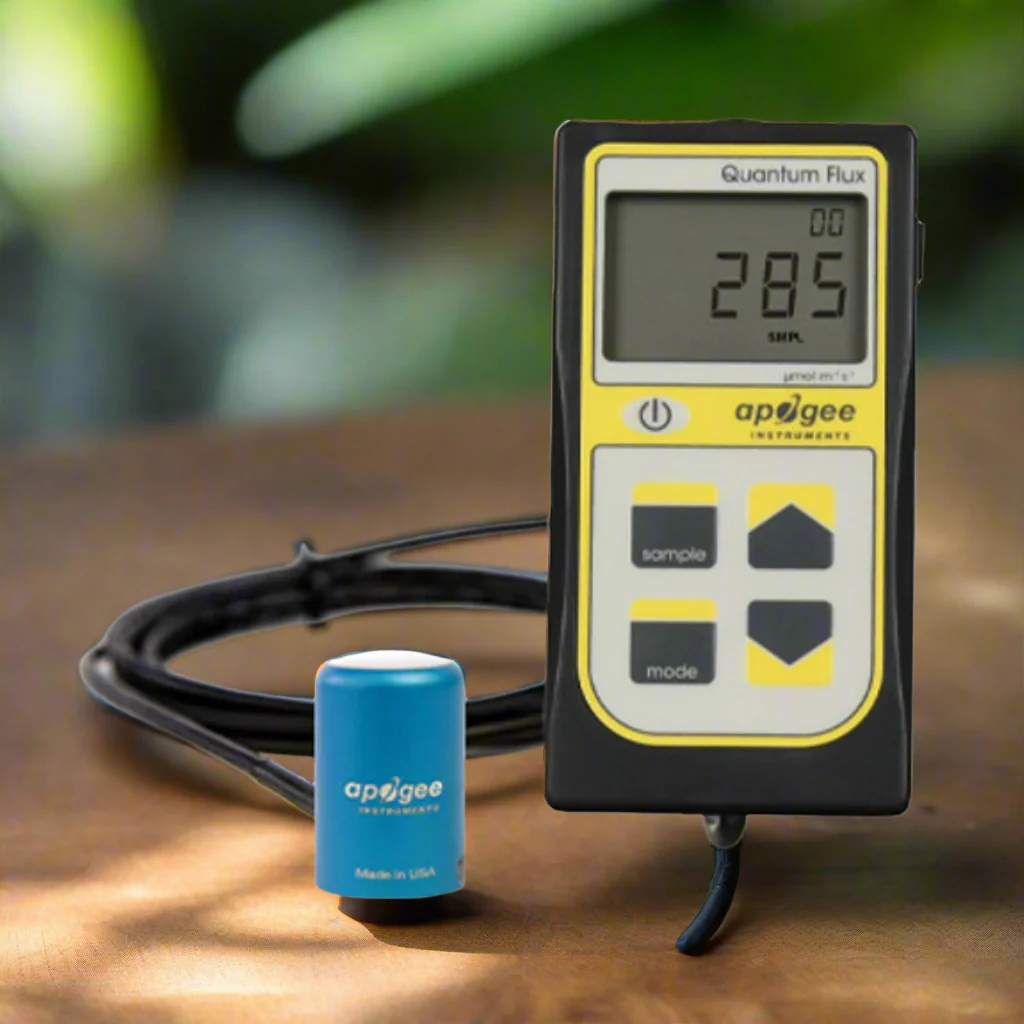
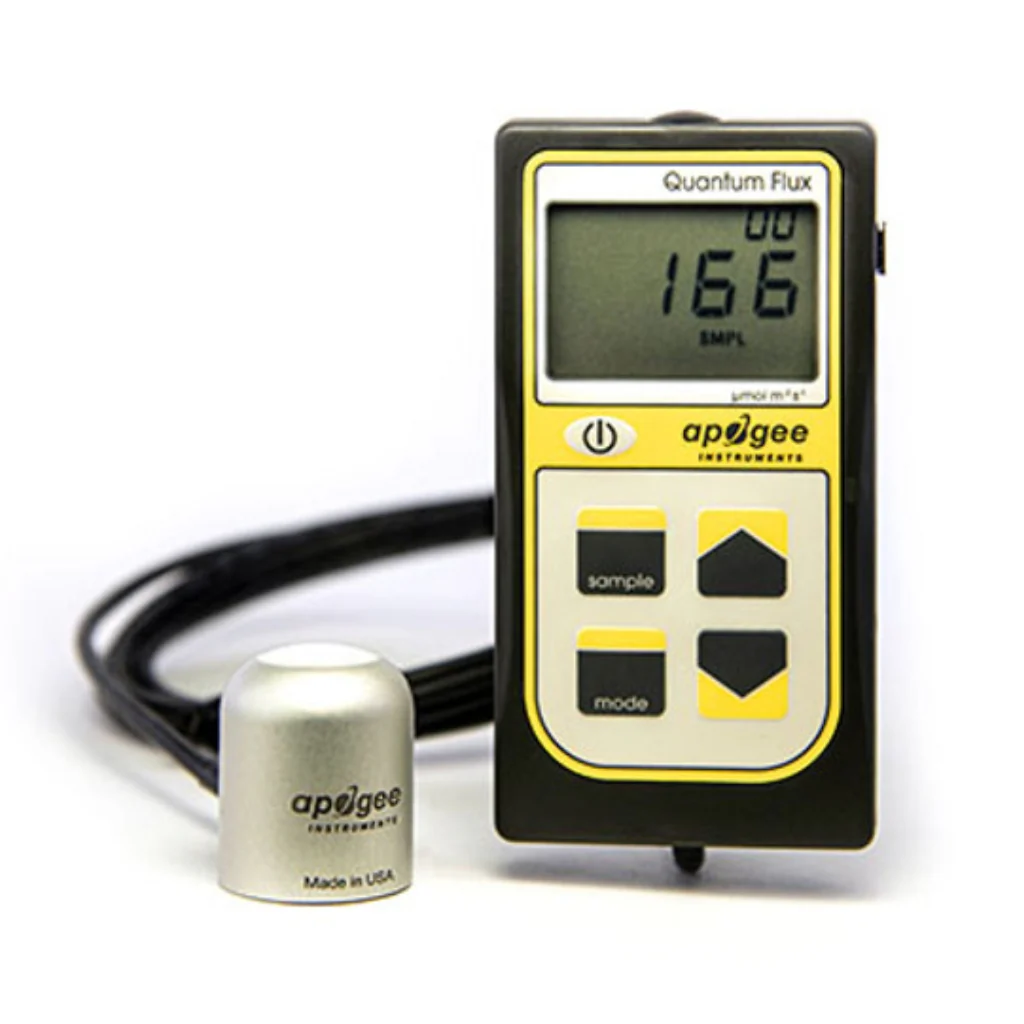
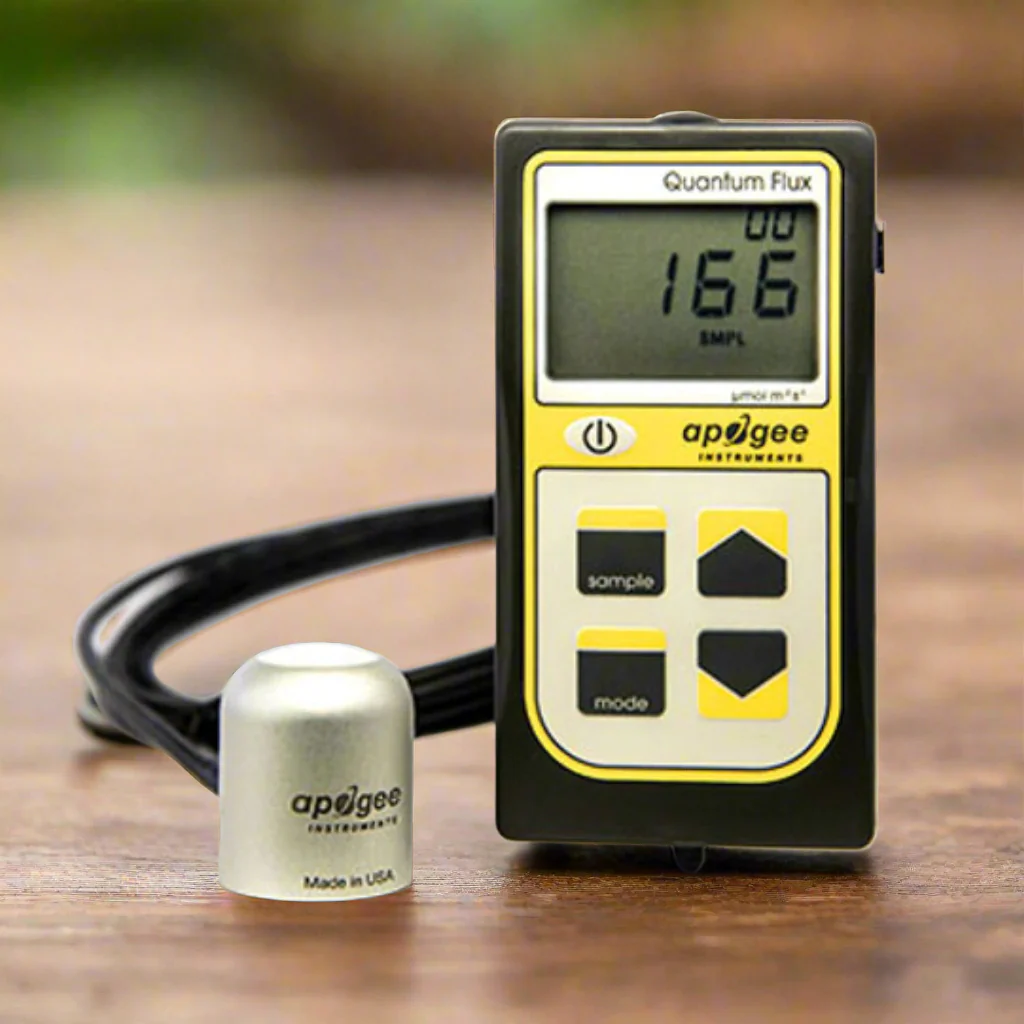
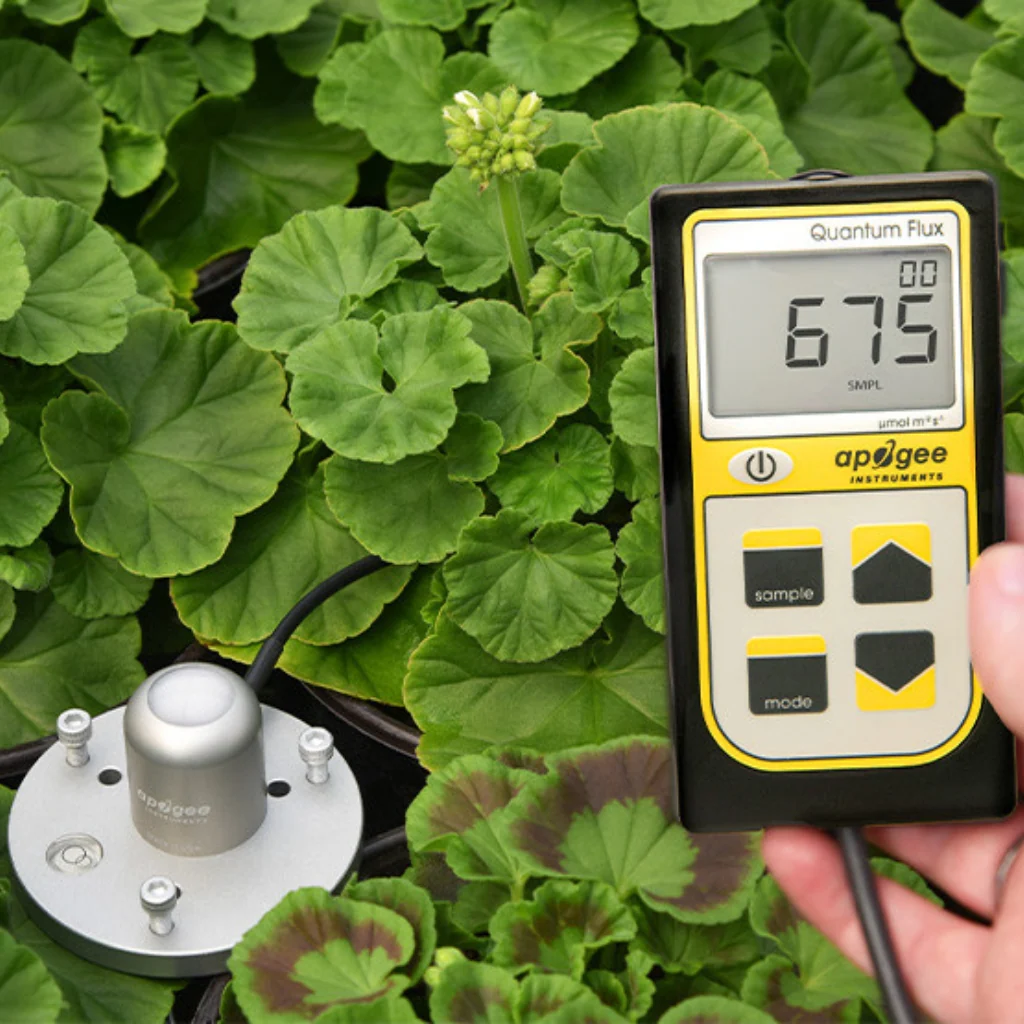
Apogee MQ610 400-750 nm ePAR Meter
For Scientists & Serious Growers
Designed by the Apogee Instruments’ engineering team under the direction of world-renowned crop physiologist, Bruce Bugbee, PhD, the MQ-610 ePAR meter is the first in its class among leading scientists and serious growers for accurately measuring the new extended photosynthetically active radiation (ePAR) from 400 to 750 nm for all light sources.
New ePAR Range
Laboratory-grade measurement of the newly defined 400-750 nm ePAR has been found to be photosynthetically active beyond the traditional 400-700 nm (PAR). Much of the transformative work to define the ePAR range was conducted by Dr. Shuyang Zhen and Dr. Bruce Bugbee. The MQ-610 can accurately measure far-red photons (700-750 nm), found in many next-generation LED fixtures, the sun, and other light sources, which cannot be measured by traditional PAR meters.
Quality ePAR Meter
Unlike commonly available LUX or footcandle meters used for measuring light for human vision, our meters feature a laboratory-grade ePPFD (extended photosynthetic photon flux density) optical detector precisely calibrated to measure the light intensity in µmol m-2 s-1 of the specific color wavelengths (including far-red) emitted by LEDs, HPS, MH, sunlight, and other light sources utilized by plants for photosynthesis. The sensor contains a precision silicon photodiode detector, a custom optical filter, and an acrylic diffuser all housed in a self-cleaning, dome-shaped, anodized aluminium sensor head.
Extremely Accurate & Stable
Precisely measures and combines the intensity of all photons between 400 and 750 nm to give a single ePAR reading in µmol m-2 s-1 within 5 % uncertainty. Our ePAR meter has a stable, accurate calibration with an accuracy drift rate of less than 2% per year.
Three Measurement Modes
The meter has a spot measurement, sample, and log mode and will record an integrated daily total in mol m-2 s-1. Sample mode will record up to 99 manual measurements and log mode will power the meter on and off to make a measurement every 30 seconds. Every 30 minutes, the meter will average the sixty 30-second measurements and record the averaged value to memory, up to 99 averages. Once full, it will overwrite the oldest measurements with new ones. A daily light integral will be recorded from the 48 averaged measurements for a day’s worth of readings and is downloadable via Apogee AC-100 cable.
Rugged & Ready to Use
The sensor head is machined aluminium and potted solid with epoxy for years of use in harsh environments, including underwater. The handheld meter is attached by a cable and displays real-time readings, records samples, and logs average intensity and daily light integral (DLI) measurements. Unlike the sensor head, the handheld meter is not waterproof.
Made in The USA
All meters are designed, built, and calibrated at our headquarters in Logan, Utah, USA. Apogee Instruments has been creating research-grade instruments for scientists and serious growers for over 25 years. All meters are backed by our industry-leading four-year warranty and supported by our world-class, US-based customer support team.
How is the MQ-610 different from previous Apogee quantum sensors?
The MQ-610 is an extended photosynthetically active radiation (ePAR) sensor with a spectral range of 400 to 750 nm ± 5 nm, which can be seen in the graph below.
Where is the MQ-610 used?
The MQ-610 is used for measuring the newest generation of LED grow lights with wavelengths outside the traditional 400-700 nm PAR range. Research has shown the value of adding far-red LEDs to fixtures to control various diseases, achieve certain photomorphogenic effects, and even gain additional photosynthesis. The extended range filter of the MQ-610 allows it to measure photons from PAR and Far-red.
Calibration Uncertainty
± 5 %
Measurement Range
0 to 4000 µmol m-2 s-1
Measurement Repeatability
Less than 0.5 %
Long-term Drift (Non-stability)
Less than 2 % per year
Non-linearity
Less than 1 % (up to 4000 µmol m-2 s-1)
Response Time
Less than 1 ms
Field of View
180°
Spectral Range
400 to 750 nm ± 5 nm (wavelengths where response is greater than 50 %)
Directional (Cosine) Response
± 2 % at 45° zenith angle, ± 5 % at 75° zenith angle
Azimuth Error
Less than 0.5 %
Tilt Error
Less than 0.5 %
Temperature Response
-0.11 ± 0.04 % per C
Uncertainty in Daily Total
Less than 5 %
Housing
Anodized aluminium body with acrylic diffuser
IP Rating
IP68
Operating Environment
-40 to 70 C; 0 to 100 % relative humidity; can be submerged in water up to depths of 30 m
Meter Dimensions
126 mm length, 70 mm width, 24 mm height
Sensor Dimensions
30.5 mm diameter, 37 mm height
Mass (with 5 m of cable)
140 g
Cable
2 m of two conductor, shielded, twisted-pair wire; additional cable available; TPR jacket
Warranty
4 years against defects in materials and workmanship
Manufactured
Made in the USA
Original: $851.09
-65%$851.09
$297.88Product Information
Product Information
Shipping & Returns
Shipping & Returns
Description
For Scientists & Serious Growers
Designed by the Apogee Instruments’ engineering team under the direction of world-renowned crop physiologist, Bruce Bugbee, PhD, the MQ-610 ePAR meter is the first in its class among leading scientists and serious growers for accurately measuring the new extended photosynthetically active radiation (ePAR) from 400 to 750 nm for all light sources.
New ePAR Range
Laboratory-grade measurement of the newly defined 400-750 nm ePAR has been found to be photosynthetically active beyond the traditional 400-700 nm (PAR). Much of the transformative work to define the ePAR range was conducted by Dr. Shuyang Zhen and Dr. Bruce Bugbee. The MQ-610 can accurately measure far-red photons (700-750 nm), found in many next-generation LED fixtures, the sun, and other light sources, which cannot be measured by traditional PAR meters.
Quality ePAR Meter
Unlike commonly available LUX or footcandle meters used for measuring light for human vision, our meters feature a laboratory-grade ePPFD (extended photosynthetic photon flux density) optical detector precisely calibrated to measure the light intensity in µmol m-2 s-1 of the specific color wavelengths (including far-red) emitted by LEDs, HPS, MH, sunlight, and other light sources utilized by plants for photosynthesis. The sensor contains a precision silicon photodiode detector, a custom optical filter, and an acrylic diffuser all housed in a self-cleaning, dome-shaped, anodized aluminium sensor head.
Extremely Accurate & Stable
Precisely measures and combines the intensity of all photons between 400 and 750 nm to give a single ePAR reading in µmol m-2 s-1 within 5 % uncertainty. Our ePAR meter has a stable, accurate calibration with an accuracy drift rate of less than 2% per year.
Three Measurement Modes
The meter has a spot measurement, sample, and log mode and will record an integrated daily total in mol m-2 s-1. Sample mode will record up to 99 manual measurements and log mode will power the meter on and off to make a measurement every 30 seconds. Every 30 minutes, the meter will average the sixty 30-second measurements and record the averaged value to memory, up to 99 averages. Once full, it will overwrite the oldest measurements with new ones. A daily light integral will be recorded from the 48 averaged measurements for a day’s worth of readings and is downloadable via Apogee AC-100 cable.
Rugged & Ready to Use
The sensor head is machined aluminium and potted solid with epoxy for years of use in harsh environments, including underwater. The handheld meter is attached by a cable and displays real-time readings, records samples, and logs average intensity and daily light integral (DLI) measurements. Unlike the sensor head, the handheld meter is not waterproof.
Made in The USA
All meters are designed, built, and calibrated at our headquarters in Logan, Utah, USA. Apogee Instruments has been creating research-grade instruments for scientists and serious growers for over 25 years. All meters are backed by our industry-leading four-year warranty and supported by our world-class, US-based customer support team.
How is the MQ-610 different from previous Apogee quantum sensors?
The MQ-610 is an extended photosynthetically active radiation (ePAR) sensor with a spectral range of 400 to 750 nm ± 5 nm, which can be seen in the graph below.
Where is the MQ-610 used?
The MQ-610 is used for measuring the newest generation of LED grow lights with wavelengths outside the traditional 400-700 nm PAR range. Research has shown the value of adding far-red LEDs to fixtures to control various diseases, achieve certain photomorphogenic effects, and even gain additional photosynthesis. The extended range filter of the MQ-610 allows it to measure photons from PAR and Far-red.
Calibration Uncertainty
± 5 %
Measurement Range
0 to 4000 µmol m-2 s-1
Measurement Repeatability
Less than 0.5 %
Long-term Drift (Non-stability)
Less than 2 % per year
Non-linearity
Less than 1 % (up to 4000 µmol m-2 s-1)
Response Time
Less than 1 ms
Field of View
180°
Spectral Range
400 to 750 nm ± 5 nm (wavelengths where response is greater than 50 %)
Directional (Cosine) Response
± 2 % at 45° zenith angle, ± 5 % at 75° zenith angle
Azimuth Error
Less than 0.5 %
Tilt Error
Less than 0.5 %
Temperature Response
-0.11 ± 0.04 % per C
Uncertainty in Daily Total
Less than 5 %
Housing
Anodized aluminium body with acrylic diffuser
IP Rating
IP68
Operating Environment
-40 to 70 C; 0 to 100 % relative humidity; can be submerged in water up to depths of 30 m
Meter Dimensions
126 mm length, 70 mm width, 24 mm height
Sensor Dimensions
30.5 mm diameter, 37 mm height
Mass (with 5 m of cable)
140 g
Cable
2 m of two conductor, shielded, twisted-pair wire; additional cable available; TPR jacket
Warranty
4 years against defects in materials and workmanship
Manufactured
Made in the USA